What a Beauty Claim Actually Says
Learn how to read a beauty claim by separating its observable promise from suggestive wording, so you can compare products on what they actually say.
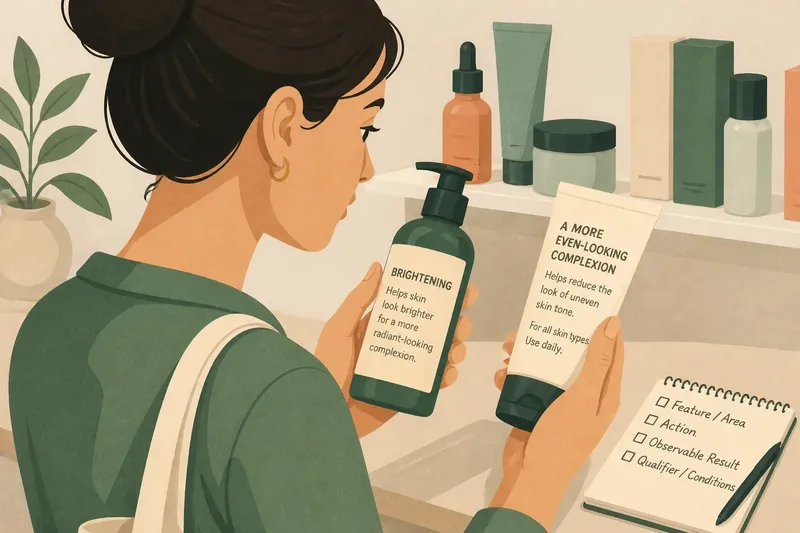
A bottle says “brightening”, while another promises “a more even-looking complexion”. To compare those beauty claims, look for the result each one names, the area it applies to and the conditions attached. That small reading habit can turn a polished promise into something you can assess.
A beauty claim is wording about what a product is meant to do or how it is meant to make something look or feel. It may be precise, broad or mostly suggestive. Your task is not to decide whether every line is true from the front label; it is to work out what the line actually commits the product to, then check whether the rest of the packaging gives that promise useful boundaries.
What is the exact promise?
Start with the main claim as printed, not the impression you get from the colour, name or image. Read the whole phrase, including small qualifiers such as “helps”, “look of”, “for a fresh finish” or “up to”. Those words can make a substantial difference to what is being promised.
Then ask what would be observable if the claim were met. “Leaves skin feeling soft” points to a sensation; “adds shine” names a visible finish; “covers redness” suggests a change in appearance. By contrast, “glow”, “radiance” and “beauty boost” may sound appealing without specifying a particular result.
Try replacing the claim in your mind with a plain sentence: “After using this, I should be able to notice…” If you cannot finish that sentence without adding your own interpretation, the claim is probably broad. That does not automatically make it misleading or useless; it means you have less specific information to compare.
Which words define or soften the result?
Look for the claim’s subject, action and qualifier. The subject might be skin, lashes, hair or the appearance of a particular area. The action tells you what changes: smooths, colours, holds, moisturises or cleanses. A qualifier narrows the promise, perhaps to a temporary appearance, a particular finish or use under certain conditions.
- “Helps” signals a contribution rather than a promise that the product acts alone.
- “Look of” describes appearance, not necessarily a physical change to the feature named.
- “Long-wearing” raises a question about what is meant to last, and in what conditions.
- “For sensitive skin” identifies an intended audience, but does not tell you how every individual will respond.
- “Up to” marks an upper limit or best-case framing; check what result and conditions it refers to.
These phrases are not interchangeable, and none needs to be treated as proof by itself. Read them as part of the claim’s scope. A sentence such as “helps skin look smoother” is a narrower promise about appearance than an unqualified claim that a product “smooths skin”.
What evidence or explanation sits beside it?
Turn the package over and scan for a description that explains how the headline claim is framed. Look for usage directions, the area of application, any stated finish and the point at which the result is expected to be visible. A product page may provide more room for this detail, but treat the headline and supporting copy as separate pieces of information.
Ask whether the supporting wording answers the question raised by the claim. If a mascara says “holds a curl”, does the description clarify that it refers to the appearance of lashes after application? If a moisturiser says “comforting”, does the copy explain the sensation or simply repeat the same vague idea with different adjectives?
Visuals can help identify the kind of result being suggested, but they do not define it reliably. A dramatic before-and-after image may imply a particular transformation without telling you the lighting, application or other conditions. Keep your interpretation anchored to the words that state the promise rather than filling gaps with the most flattering image.
How can you compare two claims fairly?
Compare like with like. Put the two claims into the same plain-language frame: what feature is addressed, what action is named, what result is observable, and what qualifier limits it? If one product promises “a soft-focus finish” and another says “reduces the appearance of pores”, they may be aiming at related visual concerns, but the claims are not identical.
Imagine you are choosing between two concealers for the look of redness around your nose. One says “natural coverage”; the other says “buildable coverage that helps conceal visible redness”. The second gives you a more specific area and result to judge, while “natural” leaves the finish open to interpretation. You would still need to decide whether the stated result matches your preference, but you can compare the promises without treating either phrase as a verdict on performance.
Make a quick note of the exact wording if you are comparing products in a shop or on a screen. This helps prevent a product name or attractive image from quietly becoming part of the promise. It also makes it easier to spot when two products use different language for a similar intended appearance.
Which questions help decode a beauty claim?
Does “brightening” mean a visible finish or a change to skin?
The word alone does not settle that. Check whether the surrounding copy says “bright-looking”, refers to a particular finish, or makes a more specific statement about skin; do not supply a meaning the label has not given.
Is “clinically tested” the same as a clear product promise?
No: it describes a testing-related claim, but does not by itself tell you what result was assessed or under what conditions. Look for a plain account of the claimed outcome and the way the product is intended to be used.
What does “dermatologist tested” tell me?
It indicates that the product has been associated with dermatological testing, but the phrase alone does not explain the test’s design or predict your personal response. If you need advice about a skin condition or a reaction, ask a qualified healthcare professional.
Can a claim be useful if it is subjective?
Yes, if it describes an experience you care about, such as a lightweight feel or dewy finish. Treat it as a preference cue rather than a precise, universal result, and check whether the rest of the description makes the sensation or appearance more concrete.
What should you do when the wording stays vague?
Keep the claim in its proper place: one piece of product information, not a substitute for knowing what you want. If the wording does not say what changes, where it changes or how the result is meant to appear, note that uncertainty rather than translating “renew”, “transform” or “perfect” into a specific benefit.
Next, use the details that are clear. Check whether the product is intended for the area you have in mind, whether its stated finish suits you and whether the directions fit the way you plan to use it. For ingredient-specific, health or safety questions, follow the product’s label and manufacturer instructions; seek qualified professional advice where it matters.
It is not worth the effort to build an elaborate theory around one glamorous adjective or to hunt for hidden certainty in a product name. If the promise remains undefined after you read the supporting copy, that is useful information: you have learned that the claim offers little basis for a close comparison.
How can you make the reading habit stick?
Use the same short sequence each time: quote the claim, name its observable result, mark its qualifiers, then check the supporting description. This keeps the process grounded in the language on the package and stops a broad mood word from doing the work of a concrete promise.
When a claim is clear, you can decide whether its stated result matters to you. When it is vague, you can compare the product using other information without pretending the slogan says more than it does. That is the practical value of reading a beauty claim closely: you leave with a sharper question, not a borrowed expectation.
Before choosing, ask yourself once more: what could I actually notice if this claim were true? For beauty claims, that plain question is often enough to separate a product’s specific promise from the atmosphere its wording creates.